I have spent five years sending messages to millions of users, and the most expensive thing I ever did was treat them all the same.
The question I kept getting wrong for years was not how to write a better message. It was who I was writing it to.
First of all, it is very important to understand that you are competing with everyone around you right now. It is not only your direct competition but all the apps that are fighting for users’ attention.
Let me be clear here: you’re competing not with apps, but with the entire digital world for user attention.
The average person now receives dozens of push notifications, emails, and in-app messages before lunch and ignores almost all of them.
I still remember reading newspapers and choosing between new wallpapers that were presented there, so I could download them. Same with ringtones. Those days are long gone, and the pace of change is astonishing.
The phone went from a novelty people showed off to a device most people wish would stop demanding their attention, and your push notification is part of that demand.
As devices evolved, so did the unspoken agreement between sender and receiver. Your strategies have to change as well. To stay relevant, you must adapt to these evolving user expectations.
Every company now has an app, which means every company now has a direct line to your users and is using it. These apps allow organizations to send extra notifications like app pushes and inmails, so now it has become very normal to send emails, app pushes, inmails, and sometimes SMS.
I know you already know this. For sure, you get tens of them on a daily basis, and you must feel exhausted as the receiver. That exhaustion that your users feel is the exact context your message lands in. For you, it might sound exciting as you spend hours engineering the perfect message that your customer will like. And from your customers’ perspective, it is noise.
It is sad, but you need to understand that these people don’t care about your product as much as you think. They will only care if they can really benefit from it. Understanding their needs is the first step to crafting messages that resonate.
Personalization is not a feature you bolt on at the end. It is the decision you make before you write a single word.
Sending the same message to every user is not neutral; it is actively teaching them that your messages are not worth opening.
Obviously, it takes an enormous amount of time sending customized messages to every individual, or does it really?
AI has transformed message creation by enabling rapid personalization and targeting. But you need to be clever about it.
I have seen brands lose reply rates overnight when users started recognizing the same AI sentence structures across competitors. The tell is always the same hollow opener. People can spot AI very quickly, and there is nothing worse for a brand nowadays than to be associated with these poor quality solutions.
However, you can still keep designing the messages that your users won’t necessarily figure out that they are AI-written.
The prompt is the asset. Write it once, pressure-test it against your brand voice, and it does the targeting work you used to hire a team for.
For example, look at these two email examples below:
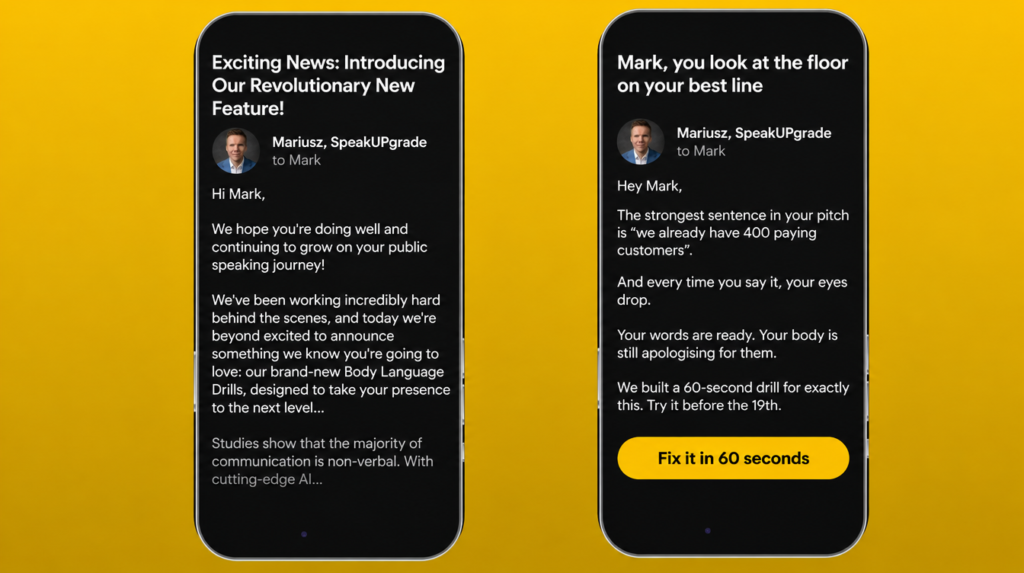
Which one are you more likely to click?
I will bet you that it will be the one on the right, even though they were both AI-generated.
Here is what separates the one that gets opened from the one that gets deleted. The message that gets opened is not the cleverest one; it is the one that makes the reader feel like it was written for them specifically.
The companies that get this right are sending a personalized message to the right person, and that person does not experience it as marketing at all.
The timing is playing a huge role as well of course.
Let’s see how the potential user journey could look.
Users receive your message and can only see its title. This is a few words that need to explain to the user what this notification is about. If you craft it precisely enough then user will already assume what information they can find inside.
Now whether the user will decide to click it depends on the offer. If it sounds interesting then they will click immediately. If not, then it was either unclear, not interesting or simply they don’t care.
Let’s assume your user clicked it and you get this journey going. Now you need to keep this user’s attention going. Explain the pain point you are about to solve for them.
I believe that it is better to start with building up tension around the problem. What will potentially happen if you ignore it? Then, you say how to resolve it and how much better this person’s life will become.
Then you want to create a proper CTA button.
I don’t believe in long messages where you are trying to convince user that your product is the right choice.
First, no one wants to spend time reading long messages nowadays.
Second, if your offer is with good timing, good quality, good pricing, and good value then clicking call to action button becomes natural to the client. You want to get the client to look for the CTA button rather than trick them into clicking it.
I am fully aware that it sounds like a lot of work, but you need to understand that AI has changed the game forever. You will either level up your game or simply disappear. It is totally okay to use AI in your content creation, but you need to make sure that AI is working for you and you are the one who dictates what and how it needs to be done.
In the end, AI is the average of the information it can find on the internet. You don’t want to be average. You want to be at the top of your game.
So stop thinking of sending one message to millions of users, start sending millions of personalized messages to each of them, and treat your users with the respect they deserve.